
Project
Soft robotics has emerged as a promising field that enables robots to interact safely with humans and delicate environments. Due to their inherent compliance and adaptability, soft fluidic actuators offer significant advantages over traditional rigid mechanisms. However, their highly nonlinear deformation and continuous motion make them particularly challenging to model, sense, and control. Unlike conventional rigid robots that rely on articulated joints and well-defined kinematics, soft robots deform continuously, making precise shape estimation and motion control significantly more complex.
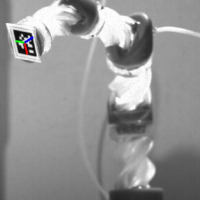
MoSoBot proposes a novel approach to soft robot design based on modular soft fluidic actuators with integrated sensing capabilities. Each module combines actuation and local sensing, allowing the robot to perceive its own deformation while interacting effectively with its surroundings. This modular architecture enables flexible robot configurations while maintaining accurate control.
The project explores a new generation of Modular Soft Fluidic Robots (SMFR) incorporating embedded sensing technologies. MoSoBot aims to design, fabricate, and control these modular robotic systems to enable adaptive manipulation, safe human–robot interaction, and operation in complex environments.
To address the challenges of sensing and control in deformable systems, MoSoBot integrates distributed sensors directly within the soft actuators. This approach provides real-time feedback on the robot’s deformation, enabling improved control of motion and more robust interaction with the environment.
Objectives
- Design modular soft fluidic actuators
- Integrate stretchable strain sensors
- Develop parametric design methods
- Optimize sensor geometry and placement
- Implement feedback control using embedded sensors